If you’ve ever rushed through detangling and heard that sickening snap of breaking strands, you know the frustration. Detangling doesn’t have to mean damage—but it does require the right approach and a little preparation before you even pick up a brush.
At Vamp Salon Extension Studio in Brentwood, CA, we detangle every texture and length daily, from fine hair prone to static to thick, curly hair that tangles the moment you look at it. What we’ve learned: the secret isn’t in how hard you brush—it’s in what you do before brushing and how you set your hair up to cooperate.
Why Hair Tangles and Breaks During Detangling
Hair tangles when the cuticle layer—the outer protective sheath of each strand—becomes raised or rough. This happens from friction (pillowcases, scarves, wind), dryness, chemical processing, or simply the natural texture of curly and coily hair, which loops around itself as it grows.
When you try to force a brush through dry, tangled hair, you’re essentially dragging a tool through interlocked strands with raised cuticles. The strands can’t slide past each other smoothly, so they stretch beyond their elastic limit and snap. This is especially true for hair that’s already compromised—color-treated, heat-styled frequently, or naturally fine.
Breakage during detangling isn’t about weak hair. It’s about friction meeting resistance without any slip or protection in between.
Start With Damp Hair, Not Soaking Wet or Bone Dry
One of the biggest mistakes we see: detangling hair when it’s either completely dry and static-prone, or dripping wet and stretched to its weakest point.
Dry hair has maximum friction and no give. Soaking wet hair is in its most fragile state—the hydrogen bonds that give hair its structure are temporarily broken when saturated with water, making strands stretch easily and snap under tension.
The sweet spot is damp hair—lightly towel-dried or misted so it has some moisture for slip, but not waterlogged. If you’re detangling before styling, this is the stage right after you’ve gently squeezed excess water out with a microfiber towel or old t-shirt.
Use a Leave-In Product That Adds Slip and Protection
This is where most people skip a step that makes all the difference. Before you touch a brush or comb to tangled hair, you need a product that does three things: adds slip so strands glide past each other, smooths the cuticle to reduce friction, and offers some protection if you’re going to heat-style afterward.
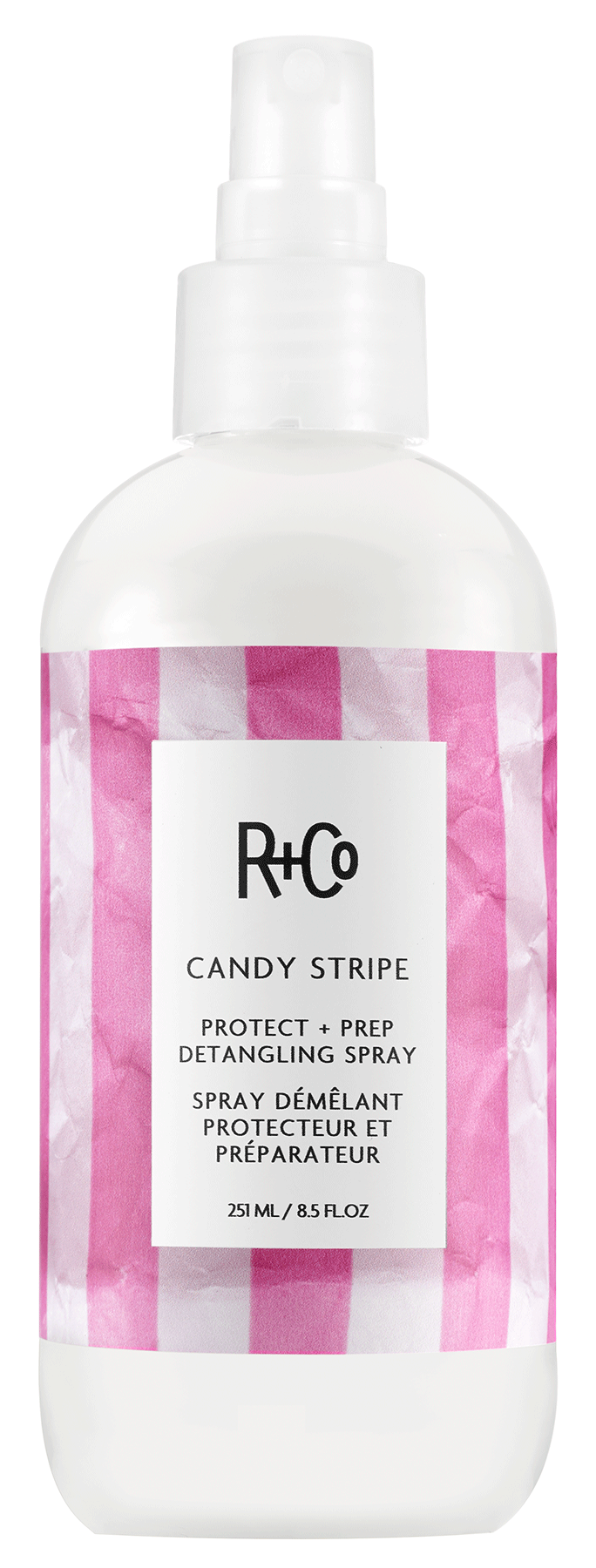
We reach for CANDY STRIPE Protect + Prep Detangling Spray from R+Co every single day at the salon. It’s a leave-in spray that preps damp hair for detangling and styling without weighing it down or leaving any residue.
What makes this spray work for detangling is the fast-absorbing formula that distributes evenly through the hair. You mist it through damp sections, and it immediately gives you the slip you need to work through knots without yanking. It’s designed to smooth the cuticle and help prevent breakage during the detangling process, which is exactly what you’re trying to avoid.
It also provides heat protection up to 450°F, so if you’re planning to blow-dry or use a flat iron after detangling, you’ve already got that base layer of protection in place. The spray leaves hair feeling smooth with a slight hold—not stiff or sticky, just enough structure that your style has some staying power once you’re done.
We carry authentic R+Co products at Vamp Salon, and you can shop the full line on our site at where to buy R+Co. CANDY STRIPE is one of those products that works across hair types—fine hair doesn’t get weighed down, and thicker or curly textures get the moisture and slip they need without feeling coated.
The Right Tools Matter as Much as Technique
Once your hair is prepped with a leave-in detangling spray, the tool you use determines whether you’ll glide through knots or create new breakage.
Wide-tooth combs are the gold standard for wet or damp detangling, especially for curly, coily, or textured hair. The wide spacing allows you to work through larger sections without disrupting the curl pattern or pulling too hard on individual strands.
Wet brushes or flexible-bristle detangling brushes work well for straighter or wavy textures. The key is that the bristles need to have some give—stiff bristles on a paddle brush will grab and snap strands instead of bending around resistance.
Avoid fine-tooth combs and natural boar-bristle brushes on wet hair. Fine teeth create too much tension on fragile, damp strands. Boar bristles are excellent for dry hair smoothing and distributing oils, but they’re not designed for detangling and will cause breakage if used on wet, knotted hair.
Work in Sections, Always Start at the Ends
This is the technique that separates a quick, damaging detangle from a gentle, effective one: you must start at the ends and work your way up toward the roots in small sections.
Here’s why. If you start at the roots and drag downward, you’re pushing every tangle you encounter down the hair shaft until they all pile up at the ends in one massive, impossible knot. By the time you reach the bottom, you’re forcing your brush through a compacted mess, and that’s when you hear the snapping.
Instead, divide your hair into manageable sections—four to six sections depending on thickness and length. Clip the sections you’re not working on out of the way.
Hold the section you’re detangling in one hand, close to the ends. Use your other hand to gently work through the last two to three inches with your wide-tooth comb or detangling brush. Once the ends are smooth, move up a few inches and repeat. Keep working upward until you reach the roots.
This method isolates each tangle so you’re only dealing with a small amount of resistance at a time. It takes a few extra minutes, but it prevents the kind of breakage that sets your hair health back by months.
What to Do With Stubborn Knots
Even with the right prep and tools, you’ll occasionally hit a knot that won’t budge. Do not force it.
Hold the hair above the knot with one hand to take tension off your scalp—this prevents the painful pulling sensation and also keeps you from yanking the knot tighter. With your other hand, use your fingers or the tip of a rattail comb to gently separate the strands within the knot. Work slowly, pulling apart a few strands at a time.
If the knot is truly locked—sometimes happens with very fine hair or hair that’s been slept on wet—mist it again with your leave-in detangling spray and let it sit for a minute. The added moisture and slip will often loosen the tangle enough that you can ease it apart without cutting.
As a last resort, if a knot is impossibly tight and you’ve spent several minutes trying to work it out, it’s better to carefully snip it out with sharp hair shears than to rip through it and break a dozen surrounding strands. This is rare, but it happens, and one small strategic cut is less damage than tearing through healthy hair.
Adjust Your Routine Based on Your Hair Texture
The core principles—damp hair, leave-in product, start at the ends—apply to everyone, but the specifics shift depending on your texture.
Fine, straight hair: Tends to tangle from static and friction rather than curl pattern. Use a light mist of detangling spray—you don’t need much—and a flexible-bristle brush. Fine hair is more prone to breakage because each strand has a smaller diameter, so be especially gentle and never detangle when fully wet.
Wavy hair: Can go either way depending on density. If your waves are fine, follow the fine-hair approach. If they’re thick and prone to frizz, treat them more like curly hair—use a bit more product, work in smaller sections, and consider detangling with your fingers first before using a wide-tooth comb.
Curly and coily hair: Detangle when damp with a generous amount of leave-in product. Many people with curly textures prefer to detangle in the shower with conditioner still in the hair, using fingers or a wide-tooth comb. If you’re detangling after the shower, make sure the hair is still damp and coated with a leave-in spray. Never detangle dry curly hair unless you’re prepared for breakage and frizz.
Thick, dense hair of any texture: The key is sectioning. Don’t try to detangle all your hair at once. Divide it into at least six sections, and work through each one completely before moving to the next. This keeps you from getting overwhelmed and rushing, which leads to rough handling.
When to Detangle: Before or After Washing?
There’s no universal rule here—it depends on your hair type and what causes your tangles.
If your hair tangles easily and you know washing will make it worse, do a gentle detangle before you shampoo. Use a leave-in spray on dry hair, work through the tangles carefully, then proceed with your wash. This prevents you from having to deal with a matted mess in the shower.
If your hair is relatively tangle-free when dry but knots up during washing, skip the pre-wash detangle and focus on being gentle in the shower. Don’t pile your hair on top of your head when shampooing—this creates knots. Instead, let it hang down your back and work the shampoo through in a downward motion. After conditioning, use your fingers or a wide-tooth comb to gently detangle before rinsing.
Post-wash is when most people do their main detangling session, and that’s when a leave-in detangling spray becomes essential. Your hair is damp, the cuticle is still slightly raised from the water, and you need that slip and protection before you start brushing and heat-styling.
Preventing Tangles in the First Place
The best detangling session is the one you don’t have to do because your hair didn’t tangle overnight or during the day.
Sleep on a silk or satin pillowcase, or wrap your hair in a silk scarf or bonnet. Cotton pillowcases create friction that roughs up the cuticle and causes tangles, especially for textured hair.
Don’t go to bed with soaking wet hair. Damp is fine for some textures, but dripping wet hair will mat and tangle as you move around in your sleep. If you wash at night, at least rough-dry your hair or let it air-dry until it’s just damp before lying down.
Trim regularly. Split ends tangle with each other and with neighboring strands. A trim doesn’t prevent all tangles, but it removes the damaged ends that are most likely to knot up. We recommend a haircut every eight to twelve weeks depending on your hair’s condition and how quickly it grows.
Keep your hair moisturized. Dry hair has a rough cuticle that catches on itself. Regular conditioning, weekly masks, and daily leave-in products keep the cuticle smooth and less prone to tangling.
When to Ask for Professional Help
If you’re consistently dealing with severe tangles, matting, or breakage no matter what you try, it’s worth coming in for a consultation. Sometimes the issue isn’t your detangling technique—it’s an underlying problem with your hair’s condition, your cut, or the products you’re using.
Book a consultations consultation at Vamp Salon
We can assess your hair’s texture, porosity, and current health, and recommend a routine that actually works for your specific needs. We’ll also show you hands-on how to detangle your particular hair type so you can replicate the technique at home without causing damage.
At Vamp Salon Extension Studio, located at 3860 Balfour Rd Suite C, Brentwood, CA 94513, we work with every hair type and texture. Whether you’re dealing with fine hair that snaps easily, thick curls that knot overnight, or color-treated hair that’s become fragile, we’ll help you figure out a detangling routine that prevents breakage and keeps your hair healthy. Call us at (925) 306-7742 or text (925) 308-3370 to schedule a consultation.
Detangling doesn’t have to be a battle. With the right prep, the right tools, and a little patience, you can work through knots without hearing that heartbreaking snap of breaking hair. Start with damp hair, use a leave-in spray that adds slip and protection, work in sections from the ends up, and give yourself the time to do it gently. Your hair will thank you.
Read more about how we write the Vamp Salon blog →