Why Blonde Hair Turns Brassy
If you’ve noticed your blonde, gray, or white hair developing unwanted yellow or orange tones between salon visits, you’re seeing what stylists call brassiness. This happens naturally over time, and understanding why helps you manage it at home.
Blonde hair is porous by nature — whether you were born with it or achieved it through lightening. That porosity means your hair absorbs everything it encounters: minerals from your water supply, environmental pollutants, product buildup, even natural oils from your scalp. Over time, these elements deposit warm pigments that shift your cool blonde toward yellow or orange.
Sunlight accelerates this process through oxidation. UV exposure breaks down the cool pigments in your hair faster than warm ones, leaving behind those brassy tones you didn’t ask for. Heat styling, chlorine, and even certain shampoos can speed up fading. The result is hair that looks dull and off-tone — not the vibrant blonde you left the salon with.
What Toning Actually Does
Toning works on a simple principle: opposite colors on the color wheel neutralize each other. Yellow’s opposite is purple, and orange’s opposite is blue. When you apply a purple-pigmented product to brassy blonde hair, those purple tones cancel out the yellow, bringing your hair back toward a cooler, more neutral blonde.
This isn’t about adding new color or changing your base shade. You’re depositing temporary pigment that sits on the hair’s surface and counteracts the warm tones that have developed. The effect is temporary — the pigment washes out gradually over several shampoos — which is why toning is something you return to as needed, not a one-time fix.
Professional toning at the salon uses stronger formulas and precise application techniques, but at-home toning products let you maintain that cool tone between appointments. The key is choosing a product with the right pigment concentration and using it consistently without overdoing it.
Book a color consultation at Vamp Salon
How to Tone Blonde Hair at Home
At-home toning works best as maintenance, not correction. If your hair is severely brassy or uneven, a professional color service will give you a clean starting point. Once you have the tone you want, home toning keeps it there longer.
The process is straightforward: you apply a purple-pigmented treatment to clean, damp hair, let it sit, then rinse. The longer you leave it on, the more pigment deposits — but more isn’t always better. Over-toning can leave hair looking dull or even slightly purple-tinged, especially on very light or porous hair.
Start conservatively. Apply the product evenly through mid-lengths and ends, where brassiness typically shows up first. If your roots are lighter or grayer, they may need less time. Check the color as you go, and rinse when you see the yellow tones neutralizing. You can always tone again in a few days if needed, but you can’t easily undo over-toning.
Our Go-To Toning Masque
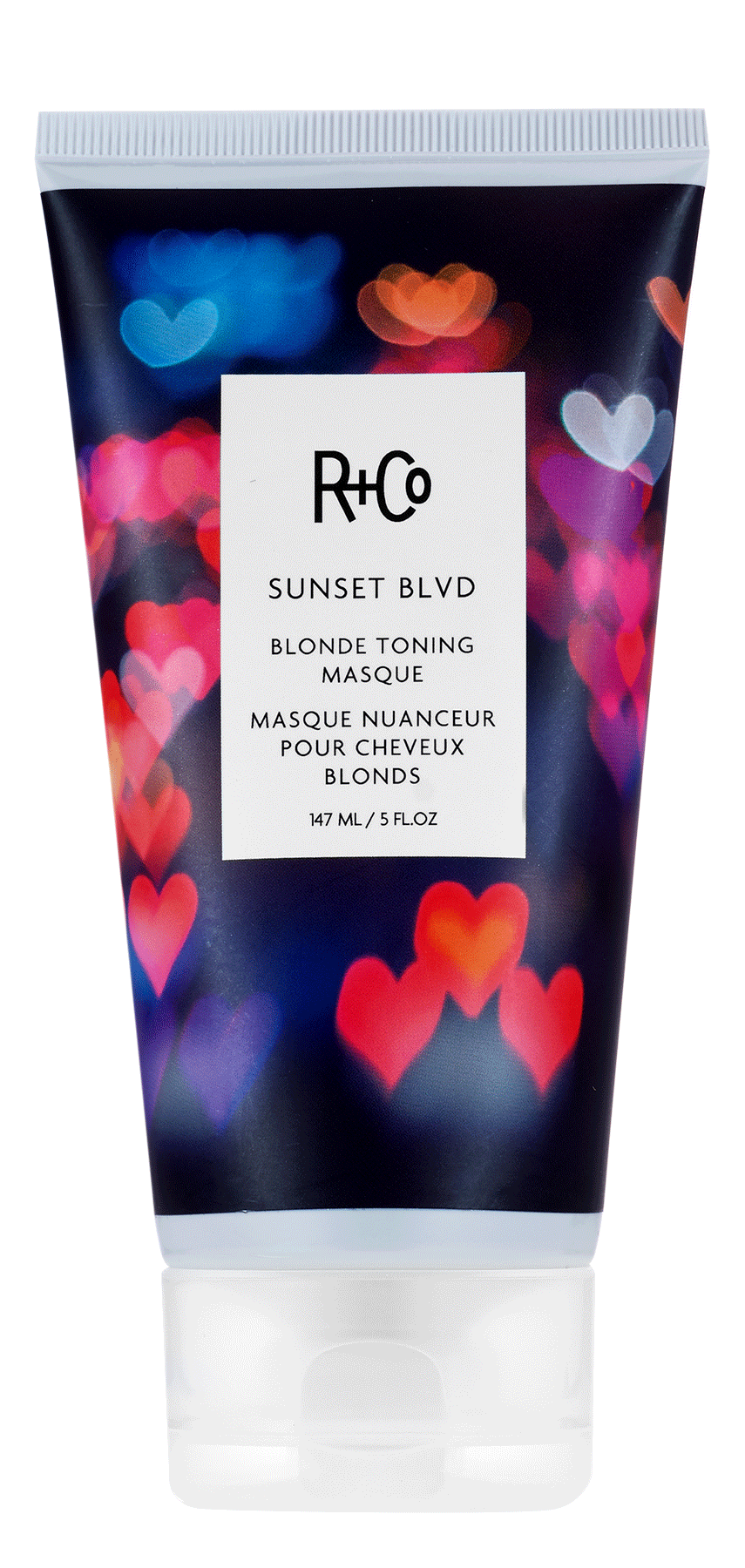
When clients ask what to use at home, we recommend SUNSET BLVD Blonde Toning Masque from R+Co. It’s formulated specifically for blonde, gray, and white hair, with naturally derived pigments from violet flower extract that neutralize yellow and prevent further oxidation.
What sets this masque apart is its dual purpose: it tones while conditioning. The deep purple pigment corrects brassiness, but the formula also detangles and softens without leaving residue or weighing hair down. You’re not choosing between tone and texture — you get both in one step.
It’s designed for use on your own schedule. Some clients use it weekly as maintenance; others apply it only when they notice warmth creeping in. The formula doesn’t require precise timing or professional technique, which makes it practical for real life. Apply it, let it work, rinse when you see the tone you want.
We carry authentic R+Co products at Vamp Salon, including SUNSET BLVD. You can pick it up during your next appointment or shop R+Co online through our site.
How Often to Tone
There’s no universal schedule for toning because every head of hair is different. Your natural porosity, the condition of your hair, how often you wash it, your water quality, and your sun exposure all affect how quickly brassiness develops.
Most people find that toning once a week maintains their color well. If you wash your hair daily or spend a lot of time outdoors, you might tone more frequently. If you wash less often or your hair is less porous, you might tone every ten days or two weeks.
Pay attention to your hair, not the calendar. When you start seeing warmth in the mirror, that’s your cue to tone. If you’re toning more than twice a week, you’re likely overdoing it — or your hair needs professional attention to address underlying issues like excessive porosity or uneven base color.
What Else Helps Prevent Brassiness
Toning manages brassiness, but a few other habits help prevent it from developing as quickly in the first place.
Use a sulfate-free shampoo designed for color-treated hair. Harsh detergents strip pigment faster and can deposit their own warm tones. Wash in lukewarm water rather than hot — heat opens the cuticle and accelerates fading. If your water is hard or high in minerals, consider a shower filter; mineral buildup is a major contributor to brassiness.
Protect your hair from UV exposure when you can. Wear a hat in direct sun, or use a leave-in product with UV filters. Minimize heat styling, and when you do use hot tools, apply a heat protectant first. Chlorine and saltwater both cause oxidation, so wet your hair with clean water before swimming and rinse thoroughly afterward.
These steps won’t eliminate the need for toning — blonde hair naturally shifts warm over time — but they slow the process and help your tone last longer between treatments.
When to See Your Stylist
At-home toning has limits. If your hair is uneven — some sections brassy, others still cool — or if the brassiness is very intense, you need professional color correction. Toning masques work on mild to moderate warmth; they can’t fix structural color issues or undo significant fading.
If you’re toning frequently and still seeing brassiness, your base color may need adjustment. Sometimes the underlying pigment is too warm, or previous color services have left the hair uneven. A stylist can assess what’s happening and recommend the right fix, whether that’s a toner, a gloss, or a color rebalancing.
Book a color consultation at Vamp Salon
Brassiness is a normal part of maintaining blonde hair, not a sign you’re doing something wrong. With the right at-home toning routine and periodic professional color services, you can keep your blonde looking fresh and cool-toned between salon visits. If you have questions about your specific hair or want personalized guidance, we’re here to help at Vamp Salon in Brentwood, CA. Call (925) 306-7742 or text (925) 308-3370 to talk through your color routine.
Read more about how we write the Vamp Salon blog →